What Are Lake Ashi and the Old Hakone Checkpoint?
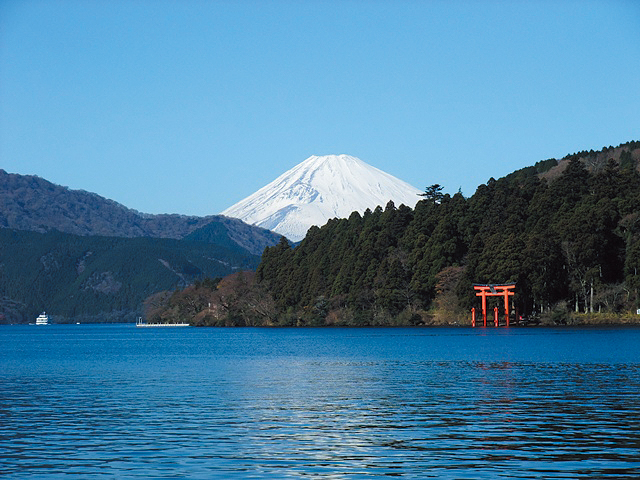
This guide is for visitors who want to know what they are looking at on the south shore of Lake Ashi. It explains how the volcano shaped the lake, what the Hakone Checkpoint was in the Edo period, and how Hakone Town rebuilt it.
We used pages from the Japan Meteorological Agency (JMA), the Ministry of the Environment, Hakone Town and its Hakone Checkpoint site, and the Hakone Town Tourist Association. All were read on 2026-10-04.
A lake made by a volcano
JMA describes Hakone as a caldera volcano. The caldera measures roughly 8 km from east to west and 12 km from north to south. Mount Kami is the main peak inside it.
JMA dates the last magma eruption to about 3,200 years ago, at Mount Kami. The north side of the mountain collapsed and caused a debris avalanche. That debris blocked the Haya River, and Lake Ashi took its present shape.
The Hakone Town Tourist Association describes Lake Ashi as a caldera lake, 724 m above sea level.
Part of a national park
Lake Ashi lies in the Fuji-Hakone-Izu National Park. The Ministry of the Environment lists its history:
- It was designated as the Fuji-Hakone National Park on 1 February 1936.
- The Izu Peninsula was added on 15 March 1955, and the park took its present name.
- The Hakone area covers 11,166 ha of land in the park.
The ministry's guide to the park describes Moto-Hakone, on the south-east shore. On clear days, Mount Fuji is reflected in the lake there. It lists Hakone Shrine, the cedar avenue on the old road, the checkpoint and groups of stone Buddhas and stone towers as sights.
What the Hakone Checkpoint was
A checkpoint, or sekisho, was a guarded gate on a main road. Hakone Town's site says the Hakone Checkpoint is said to have been set up at its present spot around 1619. Records suggest an older checkpoint stood somewhere in the Hakone hills before that.
The Hakone Checkpoint guarded the main Tokaido road. It was one of six checkpoints in the Hakone hills, and one of 53 across Japan.
The town explains that checkpoints changed over time from military forts to places for checking travellers and goods. The best-known rule was "guns in, women out." Officials watched for weapons entering Edo, and for women leaving it. The concern was that wives of feudal lords, kept in Edo as hostages, might escape home.
In 1711, the shogunate's road commissioner sent the checkpoint five rules. They were posted on a notice board just inside the Edo-side gate:
- Travellers remove hats and hoods so their faces can be checked.
- Travellers in palanquins open the doors so the inside can be seen.
- Women heading west, away from Edo, are checked closely against their papers.
- Wounded people, the dead and suspicious people do not pass without papers.
- Processions of nobles and feudal lords are not searched if the checkpoint was told in advance. Anyone suspicious among them is checked.
Daily life at the checkpoint
Most travellers seem to have passed without papers. Officials questioned them about their name, home and journey, and let them pass if nothing seemed wrong.
Women heading west were different. A woman official checked their hair and features against their papers. If the details did not match, the traveller was sent back for new papers.
The gates opened at about 6 a.m. and closed at about 6 p.m. Travellers usually spent the night at Mishima or Odawara at the foot of the hills, then climbed to the checkpoint the next day.
Crossing Lake Ashi by boat was not allowed. Two foot soldiers at a time watched the lake from the lookout post, day and night. It is the only two-storey building at the checkpoint.
How the checkpoint was rebuilt
In 1983, a detailed report on repairs to the checkpoint in 1865 was found in an archive in what is now Izunokuni City, Shizuoka. Hakone Town studied it and learned how the buildings and structures had looked.
The town excavated the site from fiscal 1999 to 2001 and compared the finds with the records. It then rebuilt the main guardhouse, the stable, a toilet, the Kyoto-side gate and other parts. These opened to the public in April 2004.
From fiscal 2004, work moved to the Byobuyama side of the site. The lookout post, the foot soldiers' guardhouse, the Edo-side gate and stone walls were restored. The checkpoint opened in full in spring 2007.
Protected as national historic sites
Hakone Town's list of cultural properties shows the site of the Hakone Checkpoint as a national historic site, designated on 8 March 1922. The old Hakone section of the Tokaido road is also a national historic site, designated on 22 September 1960.
Visiting the checkpoint
- Hours. 9:00 to 17:00 from 1 March to 30 November, and 9:00 to 16:30 from 1 December to the end of February. Last entry is 30 minutes before closing. It is open every day.
- Time needed. The checkpoint gives about 45 minutes as a standard visit.
- Admission. Adults pay 500 yen and elementary school children 250 yen. With a Hakone Freepass or similar pass, it is 400 yen and 150 yen. Elementary and junior high school students enter free on Saturdays, Sundays and holidays.
- Wheelchairs. Two are available to borrow free of charge.
- Rules. Do not eat, drink or smoke on the site, and take your rubbish home. Do not fly drones over it.
To get there, take a Hakone Tozan Bus bound for Hakonemachi-ko or an Izuhakone Bus bound for Hakone Sekisho-ato. The ride is about 55 minutes from Odawara Station or 40 minutes from Hakone-Yumoto Station. The checkpoint is a two-minute walk from the Hakone Sekisho-ato stop.
By boat, it is a five-minute walk from Hakonemachi port on the Hakone Sightseeing Cruise. There is no car park of its own.
What we could not verify, and therefore left out
- When the checkpoint closed. The town pages we read did not give the year.
- The national heritage database's own description of the site. That page redirected to an address that did not respond when we tried it.
- The depth and area of Lake Ashi.
- The history and festivals of Hakone Shrine. We found no public agency page on them during this check.
- Whether the displays at the checkpoint have English text or audio guides.
Related guides
- How do you get to Hakone from Tokyo? Trains, passes and the ropeway
- How do you stay safe in Hakone? Volcano, gas, rain and emergencies
Sources
All URLs retrieved 2026-10-04.
- 箱根山 (Japan Meteorological Agency) — (caldera size; Mount Kami; last magma eruption, collapse and the damming of the Haya River)
- 芦ノ湖・芦之湯エリア (Hakone Town Tourist Association) — (Lake Ashi as a caldera lake, 724 m above sea level)
- 概要・計画書 富士箱根伊豆国立公園 (Ministry of the Environment) — (designation in 1936; Izu added and renamed in 1955; Hakone area)
- 富士箱根伊豆国立公園 見どころガイド (Ministry of the Environment) — (Moto-Hakone and its sights; header photo)
- 関所の設置 (Hakone Checkpoint, Hakone Town) — (set up around 1619; six checkpoints in the Hakone hills)
- 関所の役割 (Hakone Checkpoint, Hakone Town) — (from forts to inspection posts; "guns in, women out"; 53 checkpoints)
- 関所の役割(箱根関所) (Hakone Checkpoint, Hakone Town) — (the five rules of 1711)
- 関所を通るには (Hakone Checkpoint, Hakone Town) — (most travellers passed without papers after questioning)
- 出女 (Hakone Checkpoint, Hakone Town) — (how women heading west were checked)
- 関所の営業時間 (Hakone Checkpoint, Hakone Town) — (gate hours; nights at Mishima or Odawara)
- 芦ノ湖の通行 (Hakone Checkpoint, Hakone Town) — (no boats across the lake; lake watch)
- 遠見番所 (Hakone Checkpoint, Hakone Town) — (the only two-storey building)
- 相州箱根御関所御修復出来形帳 (Hakone Checkpoint, Hakone Town) — (1865 repair report found in 1983)
- 箱根関跡保存整備事業 (Hakone Checkpoint, Hakone Town) — (excavation 1999 to 2001; opening in 2004 and in full in 2007)
- 箱根の文化財一覧 (Hakone Town) — (national historic site designations in 1922 and 1960)
- ご利用案内 (Hakone Checkpoint, Hakone Town) — (hours, admission, wheelchairs, rules)
- 箱根関所 (Hakone Town) — (bus, boat and car access)
- 著作権・リンクについて (Ministry of the Environment) — (site content may be used under the Public Data License 1.0)
Header photo: “Lake Ashi and Moto-Hakone” (Ministry of the Environment), https://www.env.go.jp/park/fujihakone/guide/view.html. Used under the Public Data License (PDL) Version 1.0.